🌸 Orchids

Orchids

People have grown orchids for about 2,500 years, going back to the time of Confucius in China (Fairchild Garden (opens in a new tab)). Most orchids sold today are tropical, and three of the most common are phalaenopsis, cymbidium, and dendrobium. Phalaenopsis, the moth orchid, is the one most people grow: it makes up 85 to 90 percent of orchid sales in the U.S. (University of Arkansas (opens in a new tab)). Cymbidiums are different. Their ancestors grow in cooler mountains in Asia, so in coastal California they can live outdoors all year, usually in pots (UC Master Gardeners (opens in a new tab)).

Why Climate Matters

Orchids are one of the biggest plant families, with around 28,000 species. They grow almost everywhere, from rainforest treetops to cool mountains and even north of the Arctic Circle (Kew (opens in a new tab)). Each kind is adapted to its own climate and altitude.

Phalaenopsis are the most popular orchids grown in homes and greenhouses around the world (University of Arkansas (opens in a new tab)). But they're native only to the tropics and subtropics of Asia and northeastern Australia, where they grow on trees (Kew (opens in a new tab)). Growing them and getting them to bloom means recreating the conditions of that natural habitat.

I grow mine in coastal California, where it's cooler and drier, though the fog helps. In hot, humid places like Florida or Hawaii, potting mix stays wet much longer, and in South Florida gardeners even tie orchids to trees outdoors and let the rain water them (UF/IFAS Extension (opens in a new tab)). That wouldn't work here: the air isn't humid enough, our rain is cold, and orchids can't live on trees outdoors through our colder months. In this climate they're best grown indoors or in a greenhouse.

Think about the potting mix when you repot, and adjust your watering to the mix, the climate, and your indoor conditions, like heaters and air conditioners. Bark dries fast, and sphagnum moss holds water (American Orchid Society (opens in a new tab)). In a dry area like mine, a little more sphagnum means less watering. Sphagnum also soaks up fertilizer, so you can use a lot less (Orchideria (opens in a new tab)). A good mix of bark and sphagnum is ideal.

Mounting is worth trying: the roots dry quickly between waterings, which helps prevent the root rot that overwatered pots can get (American Orchid Society (opens in a new tab)). It's a challenge, though, if you can't match the humidity and temperature orchids need.

Fun fact: California has at least 30 species of native terrestrial orchids. Two still grow wild in San Francisco: the green rein orchid and ladies' tresses. Read more from the California Native Plant Society (opens in a new tab).

My Phalaenopsis Orchids

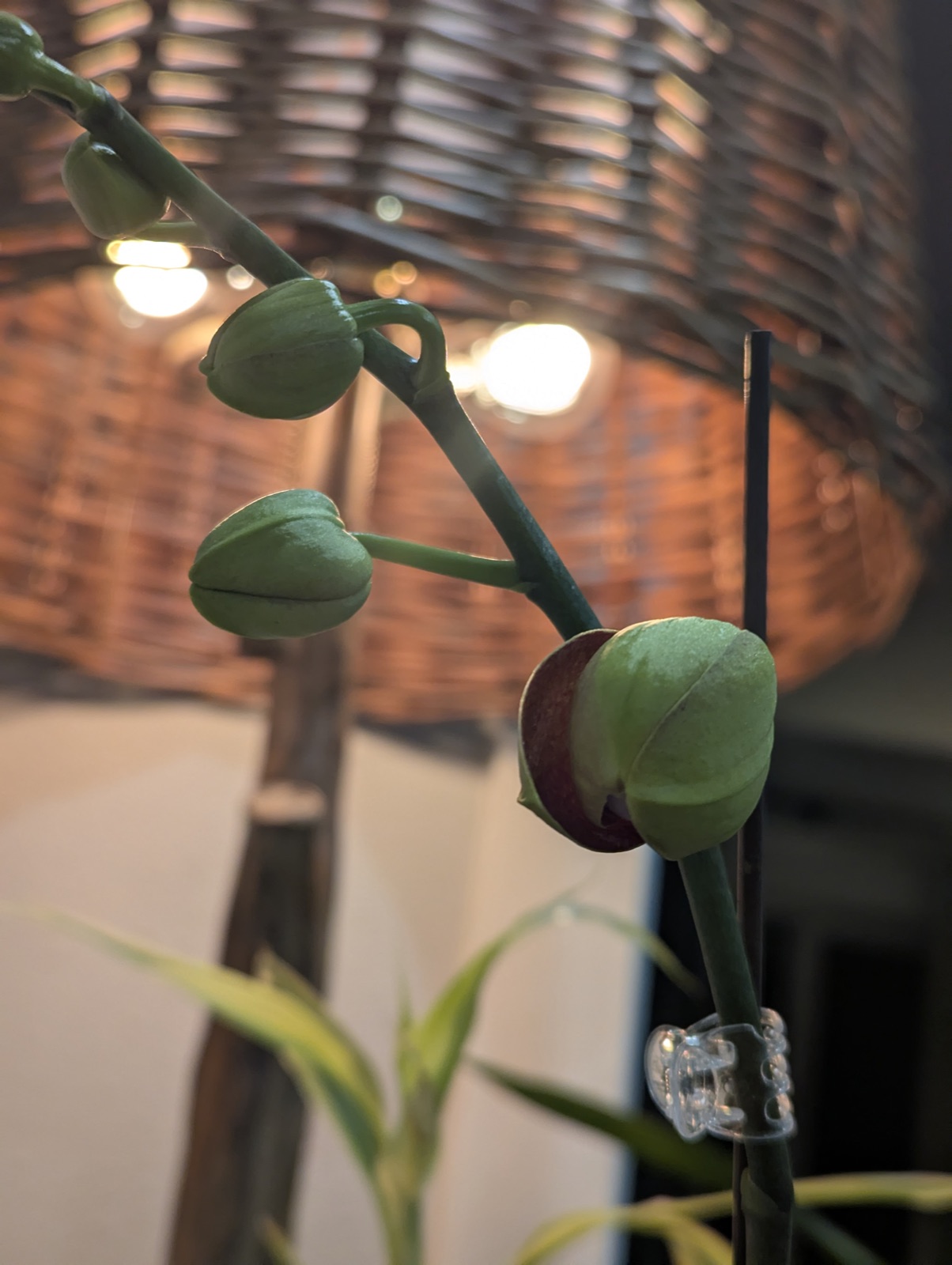
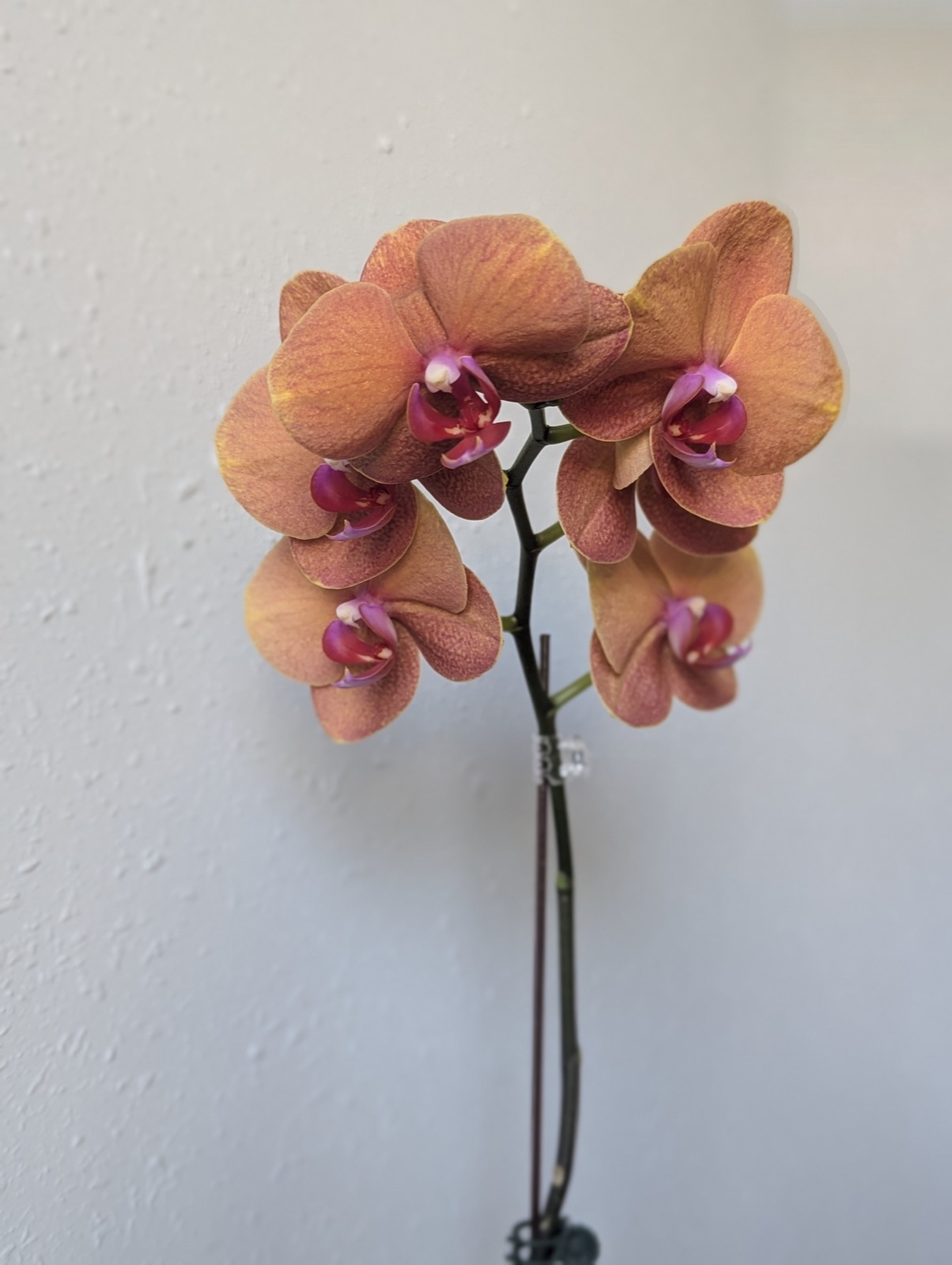
Someone left a healthy phalaenopsis in a park near me, so I brought it home. It bloomed in September: orange petals flushed with red, with a magenta lip. This was very exciting, and now I'm trying to revive my other orchids too. The surprise of the color from a rescued or unbloomed orchid is special.

A phalaenopsis flower spike with four round green buds; the lowest is starting to open and shows a dark red edge. The spike is clipped to a thin stake, in front of a wicker lampshade lit from inside.
In bud, the night before it opened, September 2026
The rescued phalaenopsis in full bloom against a plain white wall: six orange flowers speckled with red, with magenta centers, on one arching spike.
All six flowers open, October 2026
BloomingFound abandoned in a park

Abandoned Orchid, Rebloomed

Someone abandoned this orchid in a park near me. I found it in July 2026, still healthy under its spent flowers, and brought it home. It rebloomed on September 16, and by October 13 all six flowers were open. Each bud took two to three days to open fully.

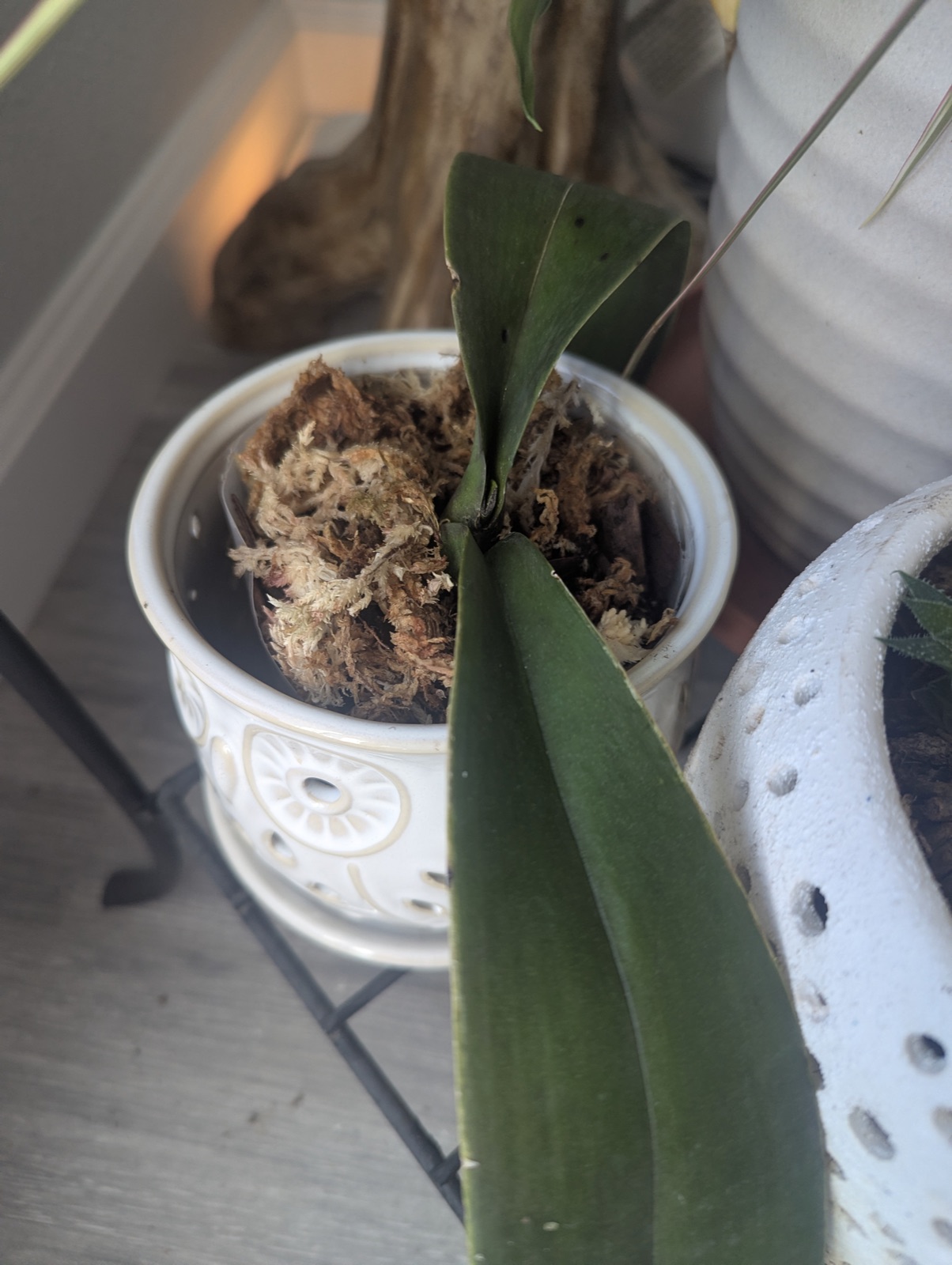
Long green phalaenopsis leaves rising from fresh, fluffy sphagnum moss in a small white ceramic pot on a plant stand.
New leaves in fresh moss, September 2026
New leavesThrown out at the Arboretum

Trash Orchid

The Arboretum threw it out because it had mealybugs, so it wouldn't infest the other greenhouse plants. I took it home, hosed it off, cleaned the mealybugs away with water and damp cotton, sprayed it with neem oil, and kept it isolated until it was clear. With good light and the right pot, it's putting out new leaves.

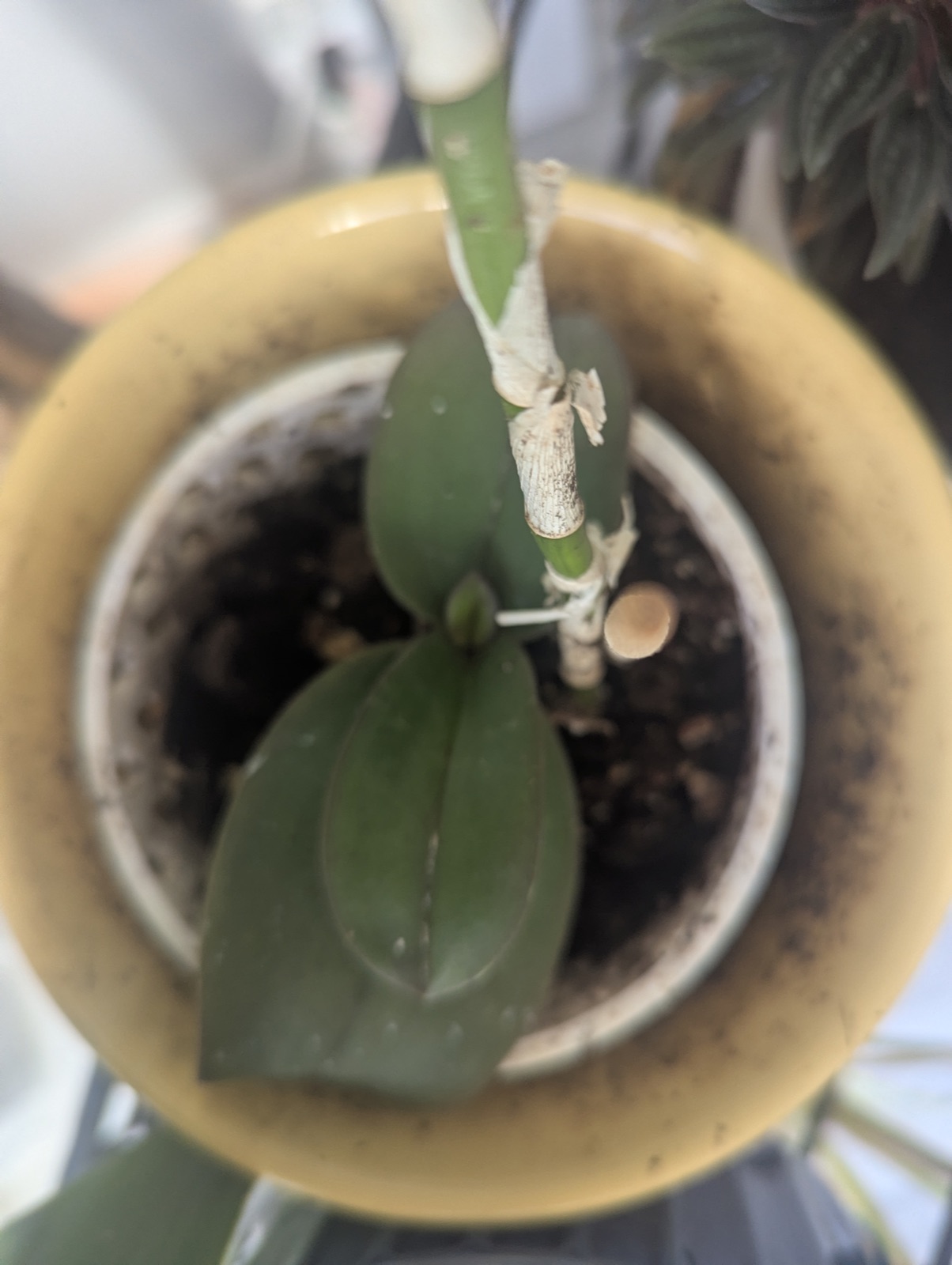
Looking down on a small phalaenopsis with a few short green leaves in a plastic orchid pot set inside a yellow ceramic pot. A pale, damaged stretch of flower spike rises from the center.
Repotted into a smaller plastic orchid pot, September 2026
Recovering

Broken Spike :(

A couple of months ago I tried to straighten its flower spike without a stake, and the spike broke. Now it's dehydrated and its leaves are small, so I repotted it into a smaller plastic orchid pot, as the orchid seminar recommends. I'm hoping the right light and pot size help it recover.

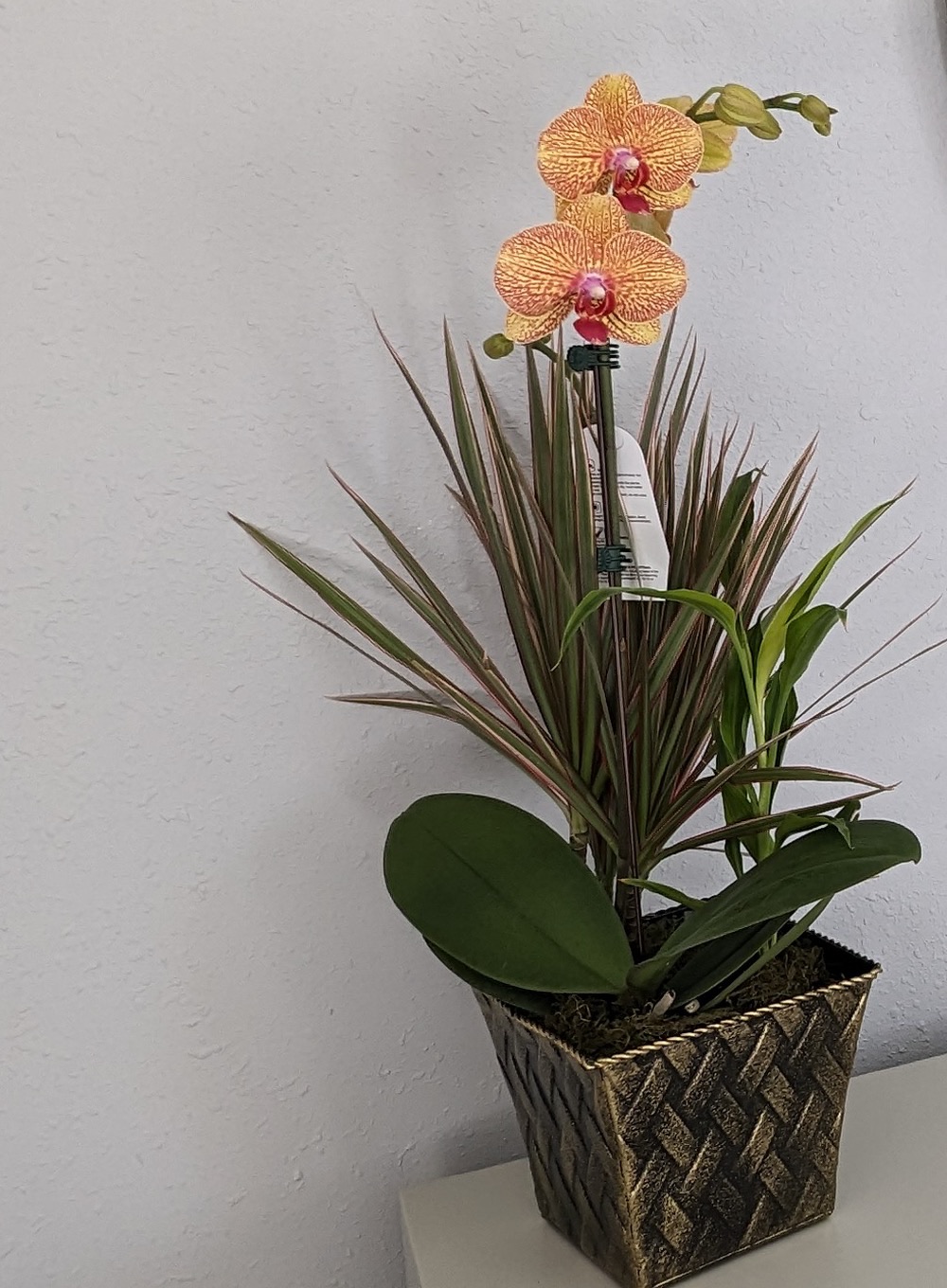
A phalaenopsis with two open orange-yellow flowers veined in red, on a staked spike, sharing a gold woven-metal pot with a spiky red-edged dracaena and another leafy plant, against a white wall.
In bloom, December 2023
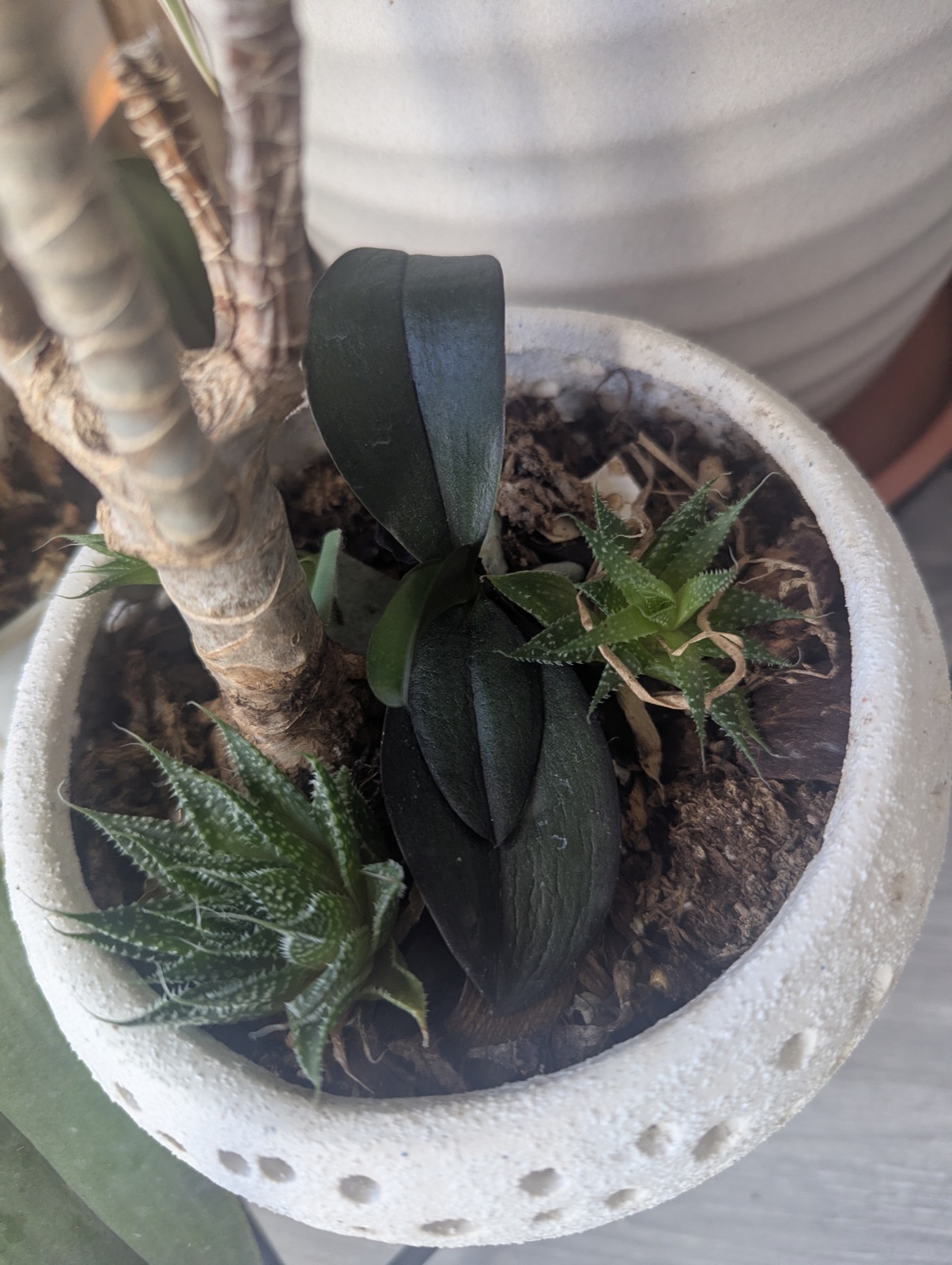
Dark green phalaenopsis leaves in a white speckled ceramic pot, crowded by two striped zebra succulents and a woody stem planted in the same pot.
Not blooming, with smaller leaves, September 2026
Not bloomingA gift, 2023

Pot Size and Solo Orchid Pot

It was a gift in 2023. It never bloomed again, and the leaves have shrunk. At the orchid seminar I learned my pot was too big. I'd repotted it like a houseplant, thinking that was right, but in hindsight I should have left it in the same pot for two years. I also planted it in with other plants, and an orchid needs its own pot.

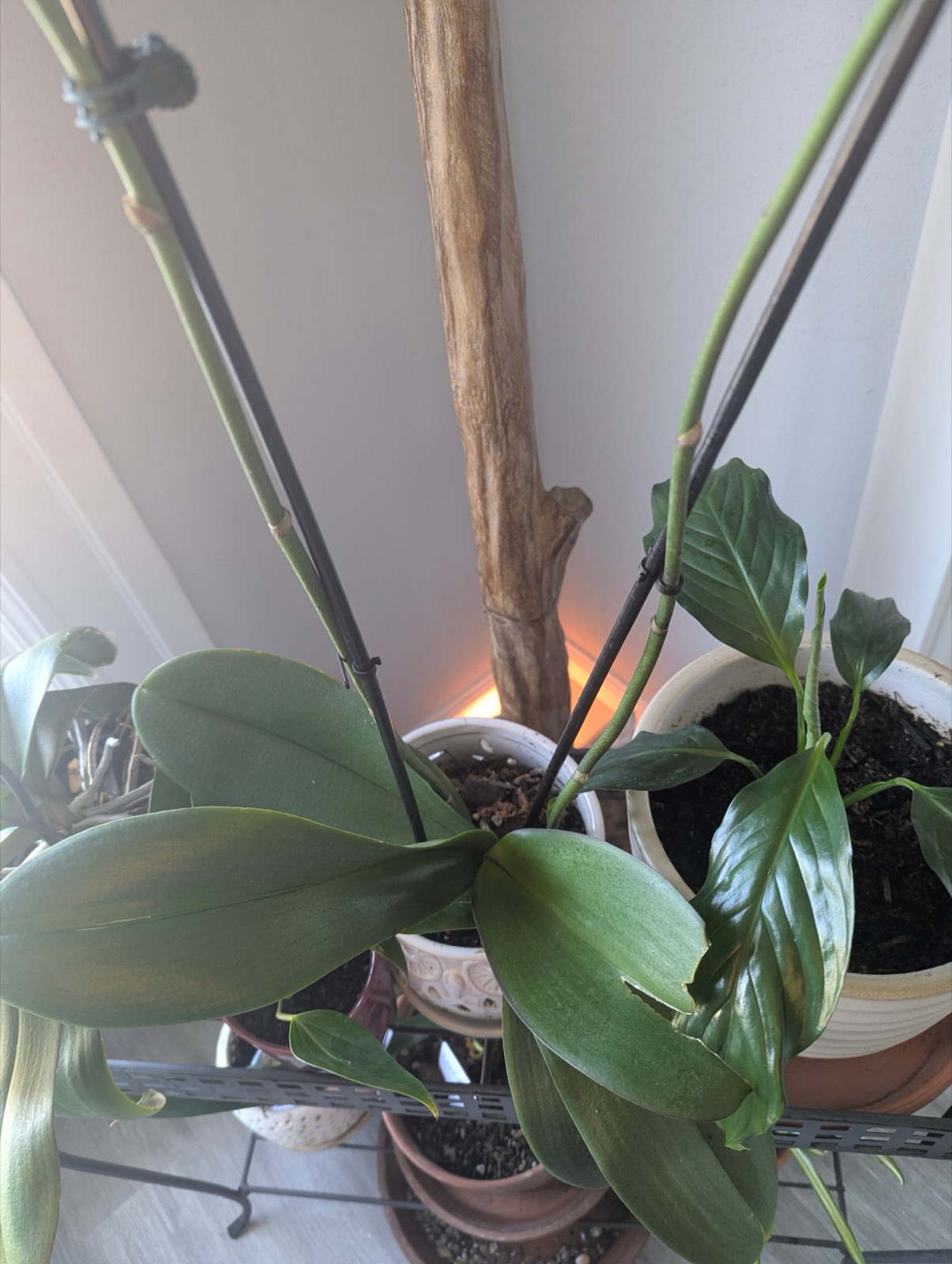
Looking down on a phalaenopsis orchid with broad green leaves in a white ceramic pot, repotted in bark with sphagnum moss on top. Two tall green flower spikes, cut off above the old blooms, are clipped to thin black stakes. A peace lily and other houseplants sit around it on a plant stand.
Repotted in bark with sphagnum on top, both spikes still green, September 2026
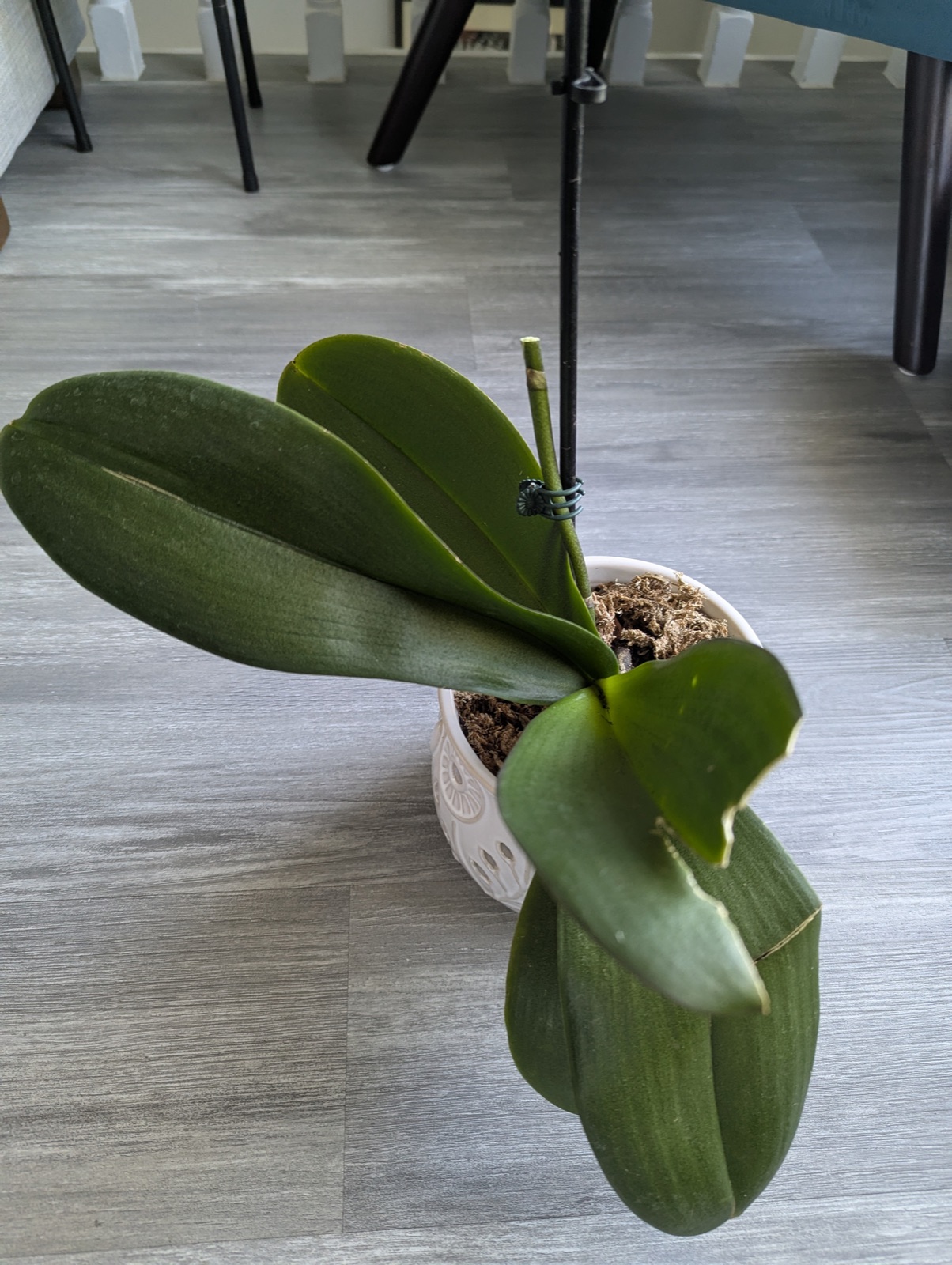
A phalaenopsis in a white ceramic pot on a gray floor, its long green leaves spreading out. One short green spike, cut above a node, is clipped to a black stake; the other spike has been cut off at the base.
After the cuts, September 27, 2026: one spike cut above its second node, the other at the base
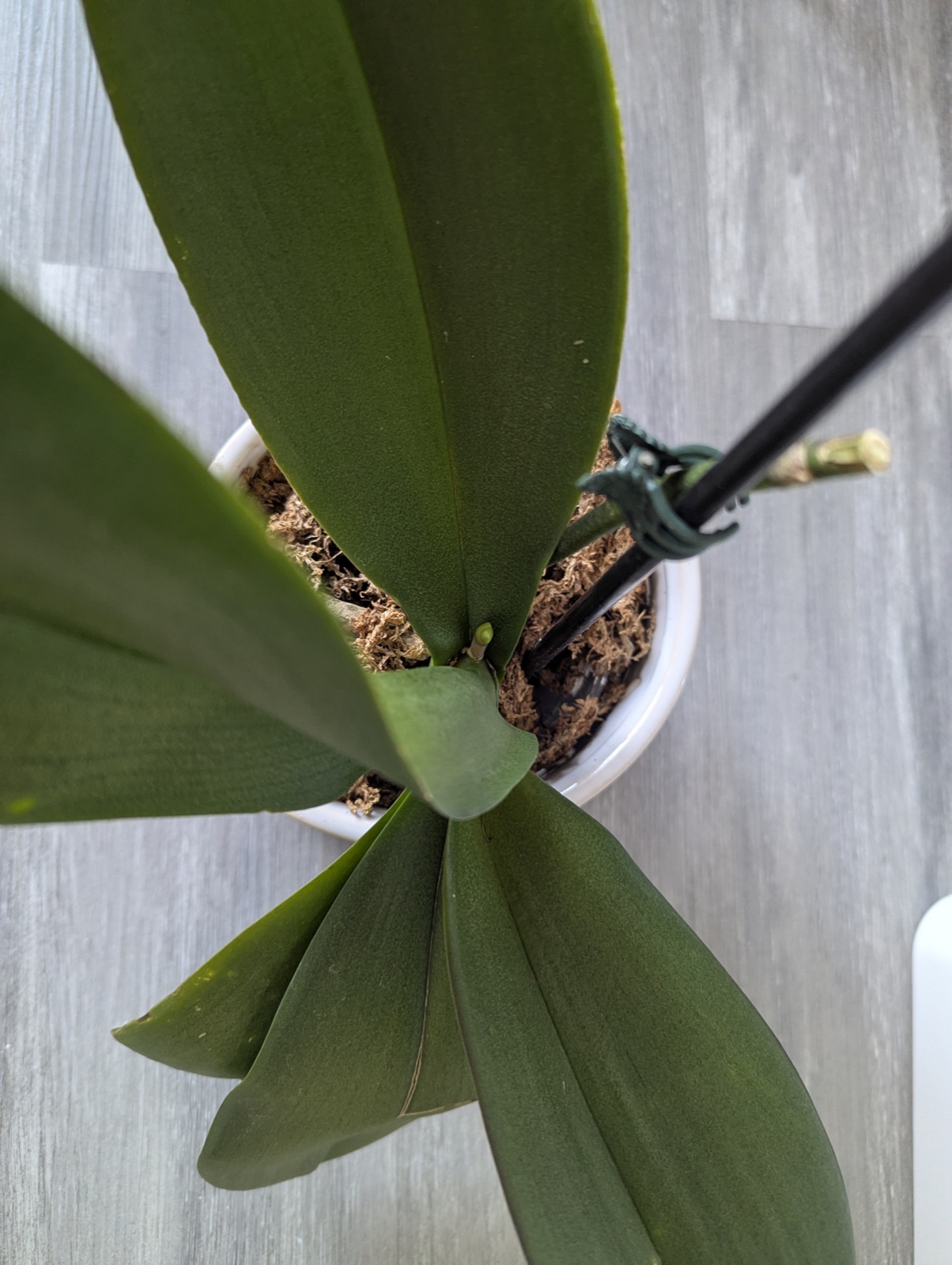
Looking down into the orchid: broad green leaves around a small new light-green leaf at the center, sphagnum on top of the pot, and the kept spike clipped to a black stake.
A new leaf at the center, October 2026
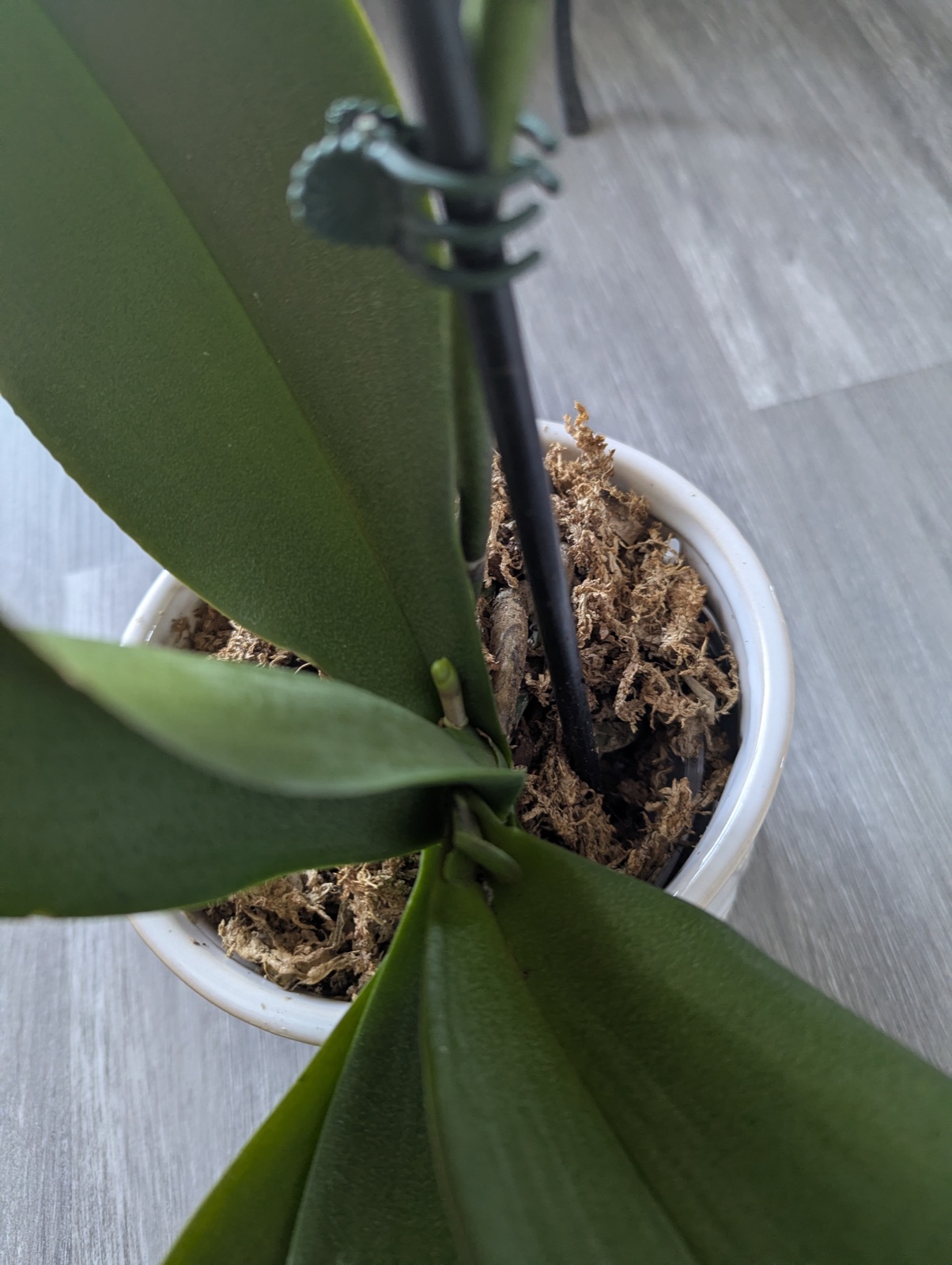
Close-up of the base of the orchid: a short green spike tip emerging between the lower leaves, above sphagnum moss in a white pot.
A small new spike starting at the base, October 2026
RecoveringA florist's gift, September 2026

Orchid Post Bloom Decisions

A florist gave us this one for free after the orchid seminar on September 6, 2026. He had cut the spikes off below the flowers. The roots were too wet from too much sphagnum moss, so I cleared away the dead roots and repotted it in mostly bark, with a little sphagnum on top to hold moisture. On September 27, 2026, I cut one spike down near the base and the other just above its second node, so it can put its energy into new roots and maybe branch. In October it grew a new leaf and a small new spike from the base. I'm waiting a little, then cutting the spike I kept down to the base, so the new growth gets the plant's energy.

Rescue Checklist

  • Keep it away from my other plants until I know it's pest-free
  • Check for pests and wipe them off with damp cotton or an alcohol wipe, then spray neem oil
  • Unpot and check the roots
  • Trim dead or mushy roots with a sterilized tool
  • If it's in bud or bloom and the roots look healthy, wait until the flowers finish to repot
  • Repot in fresh orchid mix, in a small orchid-only pot with room for no more than two years of growth

Everyday Care

  • Give it bright, indirect light
  • Keep it out of strong drafts
  • Mist regularly for humidity, early enough that the water dries off by night
  • Set a terracotta container of water and rocks near it for extra humidity
  • Keep the roots more dry than wet, but keep the air around it humid
  • Wait for the mix to dry before watering again. One way to water: set the pot in a bowl of water, let it drink for 5 to 10 minutes, then put it back in its spot
  • Fertilize every time I water with a diluted solution, or on a regular schedule, but not after it blooms
  • Stake flower spikes early so they don't break. If it's too late and the spike is delicate, leave it unstaked so it doesn't snap

Common Questions

Why are my orchid's leaves getting smaller?

Mine did that after I moved it into a bigger pot, the way I would with any other plant. Orchids like their roots packed tight, in a pot smaller than the leaves. I also planted it in with other plants, which orchids don't want. Gift arrangements often come that way.

How do I get an orchid with very few roots to grow new ones?

I haven't tried this yet, but I'm sharing it in case you want to. My gifted orchid had just one root left when I repotted it. The American Orchid Society's re-rooting answer (opens in a new tab) says to keep the air around the plant moist and the potting mix on the dry side, so the leaves stay firm until new roots grow. Repot into the smallest pot that holds the roots, water once, and put the whole pot in a clear plastic bag. Push a wire loop into the pot to hold the bag off the leaves, keep it in a shady spot, and don't water again while it's bagged. Check for new roots before you take the bag off. New roots only come with new growth, and they're slower from late September through January (American Orchid Society (opens in a new tab)).

For an orchid with no roots at all, Orchideria's sphag and bag method (opens in a new tab) sits the plant in a cup with holes inside the bag, with wet sphagnum at the other end. Leave a small air hole, because a sealed bag grows mold, and expect at least a month for the first root. The bag makes its own humid air, so it should work in a dry home too.

Can I straighten an orchid's flower spike?

Not unless a stake is already in place. I tried it on one of mine and the spike snapped. That plant is still recovering.

How do I get rid of mealybugs on an orchid?

I hosed the plant off, wiped the bugs away with water and damp cotton, sprayed it with neem oil, and kept it away from my other plants until it was clear. It's putting out new leaves now.

When should I repot an orchid?

Repot before the potting mix breaks down, and ideally when the plant is starting new roots. Signs it's time: the mix has sunk lower in the pot, the roots near the surface are dying back, the plant wobbles, or the mix feels soft when you press a finger in. Don't repot while it's in bud or bloom, because the buds can drop. If the mix has already rotted, repot right away. When you do, pick a pot with room for no more than two years of growth. This comes from the American Orchid Society's beginner's guide to repotting (opens in a new tab).

How do I get my phalaenopsis to rebloom?

It needs three things: a healthy plant, enough light to store energy, and its blooming cue. For a phalaenopsis, the cue is cooler nights. A few weeks of nights in the 50s to low 60s °F, with days no warmer than about 82°F, tell it to start a new flower spike. Bright, indirect light, like an east-facing window, keeps it fed. This comes from the American Orchid Society's rebloom guide (opens in a new tab) and phalaenopsis care sheet (opens in a new tab).

Can I use coffee grounds, eggshells, or rice water as orchid fertilizer?

I've tried all three, and they help, though they carry only small amounts of nutrients: coffee grounds mostly nitrogen (Oregon State University (opens in a new tab)), eggshells slow-release calcium (N.C. Extension (opens in a new tab)), and rice water a little nitrogen, phosphorus, and potassium (Heliyon (opens in a new tab)). A fertilizer's three numbers are N-P-K: nitrogen feeds leaves, phosphorus helps it rebloom, and potassium helps roots. For blooms, pick one whose P is higher than its N (American Orchid Society (opens in a new tab)). Read the label for magnesium and micronutrients too (boron, copper, iron, manganese, and zinc); an orchid needs them to bloom. I rotate the natural ones with a store-bought fertilizer: Espoma Orchid! (opens in a new tab), an organic one (1-3-1, high in phosphorus) from SummerWinds, or the Miracle-Gro (10-10-10) I'm using right now. Orchids need very small amounts at a time, so I mix a little into the water, soak the pot in a bowl for a few hours, then let it dry out.

Is an abandoned orchid worth rescuing?

The one I found in a park was healthy under its spent flowers. I brought it home in July 2026, and it bloomed on September 16. The color surprised me: orange petals flushed with red, with a magenta lip. I've never seen that color in stores. Not knowing what you'll get is the fun part of rescuing.

Where I'm Learning

The seminar was recorded at the Arboretum where I volunteer. The Peninsula and San Francisco orchid societies and Santa Barbara Orchid Estate grow in California's climate.

Video

Growing Orchids: Tips for San Francisco and the Bay Area Climate (Recording) (opens in a new tab)

San Mateo Arboretum Society, San Mateo, CA

Arboretum seminar on growing orchids in the Bay Area climate

Social

My Orchids Board on Pinterest (opens in a new tab)

Pinterest

Orchid care ideas I'm saving as I learn

Guide

Orchid Culture, Part 10: Repotting (AOS Beginner's Series) (opens in a new tab)

American Orchid Society, hosted by the St. Augustine Orchid Society

When and how to repot: before the mix breaks down, when new roots are starting, never in bud or bloom, and into a pot no bigger than two years of growth.

Guide

Phalaenopsis Culture Sheet (opens in a new tab)

American Orchid Society, Coral Gables, FL

Light, water, fertilizer, and potting for moth orchids. Repot every 1 to 3 years, best in spring after flowering. A few weeks of nights around 55°F start new flower spikes.

Article

Why Won't My Orchid Re-Bloom? (opens in a new tab)

American Orchid Society, Coral Gables, FL

The three things an orchid needs to flower again: good health, enough light to store energy, and its blooming cue. For phalaenopsis the cue is nights in the 50s and 60s °F.

Video

Repotting a Phalaenopsis (Video) (opens in a new tab)

American Orchid Society, Coral Gables, FL

Free video: a grower from Clown Alley Orchids repots a phalaenopsis step by step.

Article

Repotting Orchids (Napa Master Gardener Column) (opens in a new tab)

UC Master Gardeners of Napa County, Napa, CA

Northern California advice: repot new orchids out of sphagnum moss, replace bark when it breaks down, trim brown roots but keep white ones, and use a pot only slightly larger.

Website

Peninsula Orchid Society (opens in a new tab)

Peninsula Orchid Society, San Mateo Garden Center, 605 Parkside Way, San Mateo, CA

Local orchid club since 1947, affiliated with the American Orchid Society. Monthly meetings with a speaker and show-and-tell, skill sessions on repotting and mounting, and an orchid show and sale each January. Visitors welcome, and meetings are also on Zoom.

Contact
Contact form on the site; facebook.com/peninsulaorchidsociety
Website

San Francisco Orchid Society (opens in a new tab)

San Francisco Orchid Society, SF County Fair Building, 1199 9th Ave, San Francisco, CA

Bay Area orchid society since 1951. Monthly meetings in person and on Zoom, the Pacific Orchid Exposition, and Orchids in the Park in Golden Gate Park.

Guide

Phalaenopsis Growing Guide (opens in a new tab)

Santa Barbara Orchid Estate, Santa Barbara, CA

Care guide from a California coastal grower. To get a phalaenopsis to rebloom, give it about three weeks of nights in the low to mid 50s °F. Repot when the mix feels mushy.

Article

San Francisco Orchids (opens in a new tab)

California Native Plant Society, Yerba Buena Chapter, San Francisco, CA

California's wild orchids: the Jepson Manual lists 30 native species in 11 genera. Two still grow in San Francisco, the green rein orchid (Piperia elegans) and ladies' tresses (Spiranthes romanzoffiana).

Video

Fertilizing in Sphagnum Moss: 3 Incredible Methods for Orchid Growth (Video) (opens in a new tab)

Orchideria (Amanda Matthews)

Three ways to feed orchids in sphagnum moss: water the day before, water and wait at least three hours, or mist the fertilizer on. Moss holds more fertilizer than bark, so use half the usual weak dose, and skip slow-release pellets on moss.